
3. Barney

I have been homesick for most of my life.
As I get older, my homesickness feels irrational, a distraction from the drying riverbed of middle-age. But, my homesickness for Colorado persists in the little things, such as inhaling the thin mountain air while hiking in Switzerland or eating roasted chilis in Spain or that rare, single snowflake that hits my cheek as I am riding my bike home from Christmas shopping in Amsterdam.
I left Colorado at eighteen, went to a small liberal arts college, then New York City, and finally Amsterdam. During those twenty-some years, I always hoped to return to Colorado, but I always found myself drifting farther east. Almost every time I visited Denver, I would roll down my window and smell the dry Colorado prairie grass, a billowy gust from the warmer side of my childhood.
My undergraduate years were a confusing spiral of cultural anomaly. Most of the students had grown up on the East coast, attended private schools, grew up in circles of privilege. Unlike my friends from Colorado, these East-coasters skipped rounds when it was their turn, aimed their critiques at the gut, actively prioritized friendships, shopped other people’s weekend plans. They also read literature, real literature, travelled beyond Cozumel, and docked their family’s boat alongside the Kennedy’s.
By the time I moved to New York, I already was New York. The East coast had seeped into my blood and my easy rocky mountain high had been replaced by the anxious desire of intellect. Mountain biking was now Chelsea art exhibitions, back-country skiing was escargot, martinis, buried night clubs.
Years later, when I moved to the Netherlands, I was sure I would continue to grow into sophistication. I was moving to Europe after-all. But Amsterdam was a culture of the middle, the medium, and more often than not, mediocrity. Sure, there were great clubs with good music, but I now had two kids and my partner, Marieke, was unstable.
Looking back on that day on the basketball court, when I first met Clyde, there was something appealing about the ease in which he spoke to me, the quick generosity of giving me a box of Bisquick. Clyde had that familiar heart of a midwesterner, but he had also travelled enough, lived abroad, had more than enough money, and therefore struggled at that tender spot where midwestern humility was squeezed by opportunity.
Similar to Clyde, when I heard Barney’s voice for the first time and the easy manner in which he spoke, I felt a tiny sting of homesickness. His voice was sweet and gentle, the very tone reminding me of the corn fields near my undergraduate dormitory, where I would lie and read classics amongst the rustling of stalks. He was soft-spoken, but no-nonsense like Marvin, my childhood neighbor, a vet like most of the men on my block, who often came over and helped fixing things around our house or took the time to teach me how to change a lawn-mower blade.
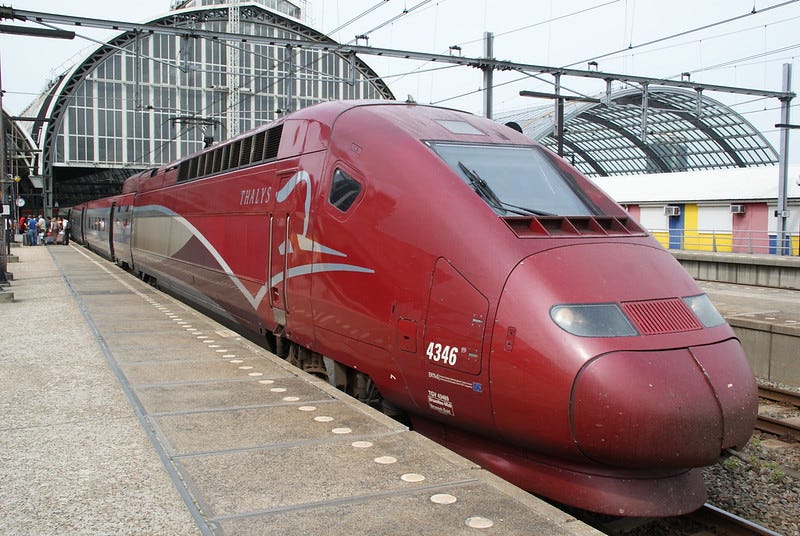
It was a Saturday morning in early spring, when I found myself waiting on the platform of Amsterdam Central Station for Clyde. Amsterdam Central Station was not welcoming or warm, the cement, metal, and vitiliginous skies streaking the vaulting glass ceiling so as to leave a traveler chilled aesthetically as well as physically. I eventually saw Clyde emerging from the hall and ascending onto the platform, speaking to Barney via video chat. Barney was in the Midwest, seven hours behind, and still out on his Friday night. I wasn’t sure Clyde had seen me at the end of the platform, but he came right up, without once lifting his eyes, and said, “Erik, say hi to Barney.” Clyde then muted the conversation and whispered out of the side of his mouth, “He’s trashed.”
Clyde lifted his phone, and as the camera auto-focused, I saw Barney’s face, subsumed in a translucent, yellow lighting, his glasses reflecting my own curious, flustered expression.
“Hey,” I said.
“Hey,” he said back.
A long day of bar food and beer had paled and wrinkled Barney’s forehead so he looked more like a young Mr. Magoo soaked not in daffiness, but in a vague, stewing hostility. I knew this kind of face, had grown up with this kind of expression, a blue-collar mask baked into a tough exterior, eagerly waiting for the right time to melt into kindness, which it did often at moments like this, in a dim bar, on the cusp of closing time.
“How are you?” I asked.
“I’m not doing good, you know.”
“He’s doing great,” Clyde said.
“I’m not.”
“You know what you need?”
“A lot of things. I’m a mess. I really am.”
“Paris!”
“Ah.”
“Remember in college we were always saying we wanted to see professional soccer in Europe? We’re going to see Paris-St.Germain tonight. You could be here in seven hours. It’ll be me, you and Erik.”
“That’s generous Clyde. You know, Krista needs me. The bills. It’d take me more than an hour just to get to Kansas City. Unemployment benefits. Can’t believe I’m saying those godawful words. Monday’s my appointment.”
Our train to Paris was delayed by ten-minutes so I went to the only Starbucks in the Netherlands and ordered a regular drip coffee, an exotic choice on a continent where variations of an espresso were the rule. One train after another pulled in, their distinct yellow and blue colored bodies streaked with mud, driver’s windows high-set eyes of a mug-faced boxer, hydraulics exhaling and groaning restlessly.
Through the Starbuck’s windows, I watched Clyde on the platform, speaking animatedly into his phone. I was surprised by his friendship with Barney. They seemed like such polar opposites. Barney feigned an air of down-home folksy while Clyde tended toward the protean jet-setters. I did understand that, as with every friendship, every relationship, there were encrypted histories, secret emotional scaffolding, and personality concatenations only understood by the two parties. And, as with so many old friendships, I also knew that, over time, the necessity of the relationship became harder to define, at least beyond their own unique durability.
To be honest, I was also surprised by Clyde’s will to be friends with me. He had texted me several times since our last meeting, inviting me out, but I had been with my two young boys. I assumed that his child-free life would eventually peel off from mine, but he persisted in connecting and this weekend trip to Paris aligned.
I returned with my coffee and a cookie for Clyde just as the Paris high-speed train pulled in. We found our places amongst the faded, out-of-style, red velvet interior and almost immediately, it rolled silently out of Amsterdam and seamlessly into a tunnel, popping my ears from the fast pressure. Barney and Clyde’s connection briefly went black. When we emerged, and our FaceTime reconnected, Barney was talking as if there had been no interruption on his end.
“You remember that one gal in L.A. The one you couldn’t leave alone?”
“Charla? Don’t bring her up.”
“We’ve been e-mailing.”
“You know what she called you, right?”
“We’ve all changed.”
“Too loyal,” Clyde said. “That’s your problem.”
My life was that of the Dutch language, teachers, friends, relatives, so listening to the pace and cadence of this American friendship brought me back. It wasn’t so much what Clyde and Barney were saying, but the playfulness, familiar idiomacy in which they spoke, that pulled me into their orbit.
“It’s been awhile,” Barney said. “I’ll take what I can get.”
“Forgot about Krista, already?”
Barney and Clyde chuckled simultaneously at this inside joke. Clyde then smiled like a prankster. “Talk to that woman behind you.”
The woman behind Barney was, in fact, a menacing-looking man with a long mullet who glared at us with furious anticipation. Barney, whose size and girth made him, like a Great Dane, inherently relaxed, absorbed Clyde’s joke, then slumped and scratched his receding hairline.
t subscribe est divina
“Did I tell you?” Barney said, leaning into his cell-phone, “I’m sure I did. I’ll tell you again. I had one of them trans people in our Kansas City department. Looked just like this guy behind me. Long hair. Make-up. Nails. Some surgery. I think. She or he. They, they, I think they say ‘they.’”
The train was picking up speed. We flew through local train stations at a dizzying speed, ruffling the waiting passengers.
“Well,” Barney continued, “this Trans, Regina or Reginald, can’t remember which, got put on some shitty postal route. Ass handed to them daily. Boy. So you know what I did? I said? I said… This was to headquarters, right, I said… You shouldn’t do that. You shouldn’t put that person on that route. But they… They thought it was funny. These guys. Rich and Len. Douche donuts, right, soft with a big hole. I told them again and again, this ain’t right. Give the Trans my route. He or She or Them shouldn’t be with them crackling Furious Five Hondas. Low-riders like that time we were in San Diego. Remember? A neighborhood with whirled-peas bumper-sticker Subarus. That’s my route. Anyway, let me ask you, would Rich and Len listen? Yes or no. I’ll give you three guesses. Oh and you know what? Guess who didn’t do anything? It’s not a surprise. That’s right. Her. LaWanda. That one. When race came into the picture, she was the first to holler. When They need help? Could hear a pin drop.”
Barney’s raw honesty, salted with bitterness, was as captivating as it was disturbing, a language of good-faith thrashing through a thicket of an elite intellectual vocabulary. It was that same sort of genuine semantic incomprehension I heard when American tourists in Amsterdam, with their ill-fitting jeans and swollen ankles, marveled through homey, passive-aggressive observations about Dutch tolerance.
Still, I felt embarrassed by what he was saying, not because I agreed or disagreed, but out of a torpid self-consciousness. Barney was muddling in the language of the educated and the ideological mess he was making - trans, poor people - his inability to properly navigate these progressive terms, was as humorous as it was disturbing. There were passengers, men whose opinions I should care less about, looking up from their financial papers with raised eyebrows. I hated myself that I had become more like them. These people were more judgmental about the way Barney was speaking than what he was actually saying.
“You know I’m angry,” Barney went on, “And Erik if you can hear, he’s still sitting there, right? I’m sorry for acting this way. I really am sorry. Erik, if you get to know me, you’ll see I’m nice, but I can get really angry. I’m sure LaWanda's a nice person, but in my book she’s, well… I can’t call her the ’N’ word. I mean could, but I won’t, because that’s just not who I am. I asked Jimmy, this other carrier who’s black if I could use the ’N’ word because I was so mad at LaWanda and he said, ‘Barney, I love you to death, but you know how to ask exactly the wrong questions,’ and I said ‘Jimmy, you know I’m an idiot, give me a break,’ and so Jimmy says, ‘Don’t I always give you a break, man.’ So I asked him to give me a word I can call LaWanda. Give me a name. Any name. But he just waves me off and says, ‘You’re doing a pretty good job yourself.’Someone has to give me a name, I said. I need a name! That woman got me fired. For what? Have I told you how I got fired? This is a good one. This is exactly what’s wrong with this country. Listen to this story. So, I didn’t want to wait for government screws to fix my desk. Instead, get this, I walked across the street to Lowes and bought my own. And that fat.. excuse me, nasty woman… LaWanda, well, she reported me. Would you ever report someone for something like that? I know I wouldn’t. You have to use government-approved screws, they said. Thirty-cent screws. That’s why I got fired. Fixing my desk with my own screws. Come on.”
“It’s not right,” Clyde said although something about his sympathy felt forced.
We were passing through Brabant, the traditional straw-thatched-homes sat lumpy and flat under the misty morning haze. Patches of land, neatly organized, slurped at the encircled moats. Here I was, racing through the Dutch countryside, but nonetheless captivated by the glow of the Pabst beer sign just behind Barney, drawn to the broken rhythm of Chris Stapleton, hungry for the buffalo wings left in a basket by the bar.
I thought Barney looked how I thought I might look if I had moved to the midwest; clean-shaven from head to chin, thin lips, a thick stew of pasty northern European genes thickened by an American middle-class lifestyle of Protestant churches, coupons, model-trains, chili-cook-offs, farmers markets with thirty flavors of honey, ice-fishing with cheap beer, outdoor concerts with struggling cover-bands, charity events with vague, demanding goals, jobs that ended exactly at five O’clock, available parking, unlimited mozzarella sticks…
“Shouldn’t you be going to bed?’ Clyde asked. He had started checking his other phone.
“I definitely should just be going bed,” Barney responded.
“Get a taxi.”
“Ain’t no taxis now.”
“Krista?”
Barney laughed. “Have fun in Paris for me. I wish I could be with you two.”
After he hung up, Clyde stared out the window, whistled through his teeth. “Man I love that guy. Getting sooo down over a postal job?”
“Maybe it’s not the job,” I said.
I was relieved that the Facetime call was over because I could no longer handle the other passengers sidelong glances. I had become one of those midwesterners who, when I moved to New York, strolled about with an unearned arrogance, referring to anything in-between New York and L.A. as the fly-over states. I had become embarrassed about one of the largest swathes of my own country for reasons vague and pretentious. Going from New York to Europe, I had also developed a self-perpetuating, collective bubble that denied the midwest was America’s heart and soul, churning out millions of common-sense people like Barney.
“I’m worried about him. He’s probably walking home now, drunk, thinking of ways to kill himself. I’ve known him for a long time. See, Barney didn’t care about anything in college. You should have seen me. I was… Shy. Shy.”
For the first time, I recognized a strand of what had kept Clyde connected to Barney. Clyde owed Barney a bit of who he had become, who he was now. But that same strand had frayed and they were both searching for a new one.