
1 - The Renovation
Barney the Butler - A Memoir

This is the first part of a series…
I was trying to write my second novel when someone purchased the house next door and began a massive renovation project. Amsterdam is built on sand so two buildings are like a couple in a canoe, the slightest adjustment of one affects the other, usually negatively. Every morning I would awake to drilling, pounding, and the beams on my roof shaking. The vibrations came straight through the floor, rattling my brain. For nine hours a day, Polish and Romanian workers gutted everything except the facade which was supported by steel beams while truck after truck carted away nearly four-hundred years of fine craftsmanship plastered under bad home improvement.
Once they had gutted the house and began to reconstruct, I watched in envy as an elevator cage was built for servicing a mere three floors. Lapis Lazuli was placed against walls, an onyx bar on the second floor, Calacatta Italian marble for all the floors, Brazilian Rosewood banisters, Murano colored-glass accenting the large bay windows, a dedicated fiber optic cable, a dozen titanium security cameras, floor warming, an elevator, wood-fired hot-tub, Wilson audio sound system, and many other things with names that I, myself, would never own.
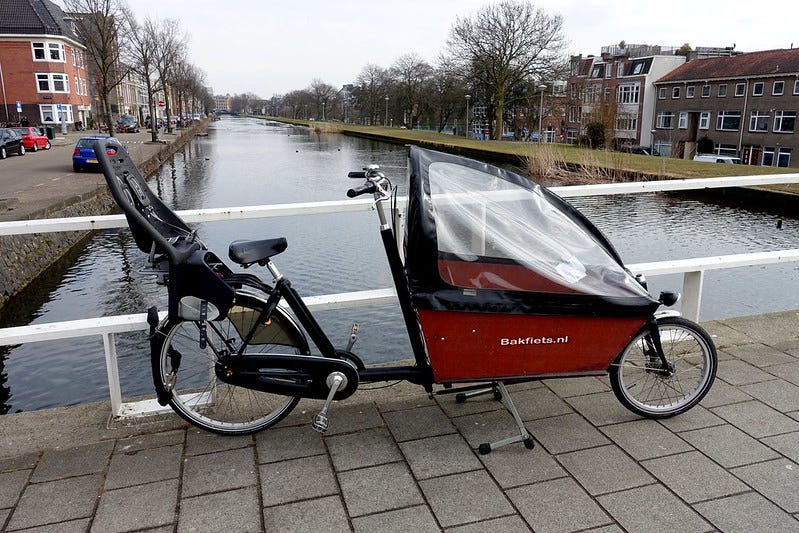
One day a construction truck backed into my bakfiets and knocked it into the canal. From my third-floor window I watched it sink rapidly into the murky depths. A bakfiets is a traditionally three-wheeled Dutch bike, with a box up front, used for transporting goods, or in my case, kids. It had cost as much as a car and was my only way to get my kids to their playdates, daycare, or to their mother’s house. I could barely hold my anger back as I approached the foreman, a jovial provincial who spoke almost accentless English.
“Let me check the security cameras,” he said, returning from the house and scratching his head. “Yup. It was us. I’ll talk to the owner and get back to you.”
The next day the foreman knocked on my door and handed me an envelope of cash. I hadn’t told him what the bakfiets originally cost, but this envelope contained nearly three times the amount I had originally paid for it.
“You’re from the US right?” he asked then tossed his head to his worksite. “So’s the owner. He’ll be here in a couple days. You should say ‘hi.’”
A few days after losing my bike, I was shooting hoops near my house, at the court in front of the Nieuwmarkt police station, when a tall, lanky guy, stopped, pointed to my shirt, and started talking in English without even asking if I spoke English:
“You a Nuggets fan?”
He was perhaps ten-years older than me. His voice was high, tone and cadence colliding with consonants. His inflection of the word “Nuggets” came out as a ragged peak that squeaked the two “gg’s” into an oscillogram of the team’s logo.
When I told him I was from Denver, he responded, “Colorado, oh man. Boulder. Love that place. Loooove it.”
I had seen him approaching from a distance because there was something about the way he walked, confident, self-absorbed, focused on his direction while completely unaware of his environment. He walked a bit like John Lennon in his Amsterdam days, shaggy, carefree, but with a shadow of imperiousness, as if he had the acute awareness of being a minor god.
He wore jeans like Jon Bon Jovi, torn and ripped at all the right places, had on a 3D polyester collared polo with shimmering ROYGBIV threads, and a pair of rare, rainbow Kobe Bryant shoes. His clothing didn’t match his age, didn’t really match any age and was more like he had tossed out some fashion ideas to an assistant before handing over his credit card. The only thing I could truly conclude from his style was that “discount” or “sale" had never been part of the conversation.
Still, he did not have the frat-boy sanctimoniousness of the Dutch, or the fashionably frazzled demeanor of the French, or the lumpy arrogance of the British who wandered around like failed colonists, or the Australians who didn’t fit neatly into any one category, but checked the boxes of almost every category. This man, now standing at an awkward distance, was definitely an American, but one salt-rubbed with new money.
“I like your shoes,” I said.
“Yeah? Last pair available. I freaked out when they had my size. Got them in Kyoto.”
“Nice. You visiting?”
“Oh you know, I just bought a small place right down the street.”
I immediately recognized the word “small” as a wolf in modesty’s sheepskin.
“You’re doing the renovation right?”
“Oh wait. Are you a neighbor? Oh dude. Seriously, my bad. I was thinking of having a party or something. As an apology.”
“To who?”
“Ev-ery-one, I mean evvvveryone, hates me now.”
“For the renovation?”
He pursed his narrow face to dramatically ask if I was kidding. I realized that the neighbor’s animosity was probably why I was remunerated for my bakfiets so quickly.
He extended his hand. “Clyde.”
“Erik.”
“Nice to meet you bro.”
We shook, soft hands clasping weakly. Behind his L.A.-skater bangs, were blue, sparkling irises that flashed like an Aldi’s signal lamp. They were the kind of eyes that were honest, inquisitive, and sincere in a way that his outward appearance concealed.
I glanced at the three boxes of Bisquick in his hands.
“I went crazy at the American store. Hunting for Combos, but they were out. Then I was like, I really want to make cinnamon rolls. I totally over did it. I need like five cups not three boxes. You like Bisquick right? Every American does, I know.”
He set a box down at my feet and made a sweeping, gracious motion with his right hand. I looked down, not sure how to respond and my lack of a response to his offer was like water poured on fire. We both glanced away, searching for something external to make the moment airborne again. When nothing came, I clumsily sunk the goodwill by saying, “I met your foreman the other day. After my bakfiets got sunk.”
“Bak what?”
“My bike.”
“Bike?”
“With the big box in the front? It’s called a bakfiets.”
Clyde nodded as if I were suddenly speaking Aramaic. When I explained how a construction truck had knocked the bike into the canal, he blinked as if genuinely baffled. He either didn’t remember or the foreman had just gone around him and given me the money.
“Sorry about that,” he murmured, the apology issued in a flat, vague way that negated responsibility. Then he flipped back to his initial perkiness. “I’ll make it up to you, dude. Come by for a drink tomorrow. My friend, Sarah, hey, she’s from Colorado too. Colorado Springs. I mean, she lives in Brussels, but you know… She’s great. You should meet her. You two can talk about skiing or something.” Then he looked me up and down, where he was actually aware of me and not just posturing. “Hey, you’ll be my first real guest.”
I nodded coolly through a hot flow of validation, of this rich man inviting me, to be his first guest. Our good-bye was awkward, full of rustling eyebrows and limp waving. I returned to my solo basketball game, took a three-point shot, and my airball soared.